Share

Offshoring to South Africa allows UK businesses to build skilled, English-speaking teams. For UK businesses facing rising employment costs and persistent skills shortages, it offers access to cost-effective top talent. It also provides a practical route to building an integrated offshore team in a favourable time zone. However, the success of an offshore team depends on choosing the right employment model and ensuring in-country compliance. This guide looks at the costs and benefits of building an offshore team in South Africa, and how to go about it in practice.
Offshoring vs Outsourcing
Offshoring is when a company moves jobs or processes to another country. It usually does this to access specialised skills at a reduced cost. Offshoring can also enable a company to increase its operational capacity at an expedited rate.
In contrast, outsourcing involves hiring an external company to perform tasks or deliver a service instead of relying on the business’s own employees. The provider is responsible for defined deliverables and may be located either in the same country or abroad.
Offshoring refers to where the work is performed and Outsourcing describes who performs the work.
What Is Offshoring to South Africa?
For a UK company, offshoring to South Africa means hiring people in South Africa to fulfil selected business functions while keeping its main operations in the UK. The offshore team may be employed directly by the company if it chooses to establish a local entity or through an Employer of Record (EOR) service. An offshoring approach allows a company to manage a dedicated team directly, with that team fully integrated into the business.
Why Are UK Companies Offshoring to South Africa?
South Africa has an established history of serving UK businesses across customer service, finance, technology, legal, retail and professional services. This is because offshoring to South Africa combines competitive labour costs with access to high calibre English-speaking talent and good infrastructure. Furthermore, in British summer time, South Africa is only one hour ahead of the UK and in winter, when the UK observes Greenwich Mean Time, South Africa is two hours ahead. Practically, this allows South African employees to attend UK meetings, respond to customers and work within the same delivery cycle. Together, these factors help explain why the UK is South Africa’s largest source market for global business services, accounting for around 55% of sector headcount (Business Process Enabling South Africa, BPESA, 2025).
Which Roles Can UK Companies Offshore to South Africa?
Customer-facing work remains a major part of South Africa’s offshore sector; however, the available talent extends beyond contact centres. Roles that can be done remotely and have measurable outputs are usually the easiest to offshore successfully.
Ten Roles Well Suited to Offshoring
- Customer experience and technical support.
- Finance, accounting and payroll administration.
- Business administration and virtual support.
- Recruitment and HR coordination.
- Software development, quality assurance (QA) and IT support.
- Data analysis and reporting.
- Sales development and customer success.
- Digital marketing, design and content.
- Legal process and compliance administration.
- Procurement and supply-chain support.
BPESA also highlights evolving capabilities in cybersecurity, cloud services, AI and analytics, pointing to growing options for offshoring more specialist roles. Highly regulated or sensitive work that requires UK-based authorisation or physical presence is usually best kept onshore, even if supporting processes are handled in South Africa.
How Much Can a UK Business Save by Offshoring to South Africa?
RAEORA estimates that many comparable roles cost 30–55% less than the UK equivalent. The exact saving depends on the role, seniority, employment model, benefits and exchange rate. For the most reliable comparison, use the total employment cost rather than a basic salary alone.
A proper offshore savings calculation should compare the following UK costs:
- UK salary;
- Employer National Insurance;
- Pension contributions;
- Recruitment fees;
- Equipment;
- Software; and
- Workspace
Against the equivalent South African costs:
- Salary;
- Statutory costs;
- Benefits;
- Infrastructure; and
- EOR or service-provider fees.
UK vs South Africa Offshore Team Costs by Role
Salary alone does not reveal the true cost difference between the UK and South Africa. For each role, compare the UK’s annual employment cost with the equivalent all-inclusive South African cost. Justin Durandt, Managing Director at RAEORA, explains that assessing each role separately is important because, for example, an entry-level customer support role may produce a different saving from a specialist software engineer. A recent case study is UK online electricals retailer AO World – after offshoring part of its customer contact operations to South Africa, the company reported savings of around £2 million so far, with annualised savings expected to reach £4 million (AO World results, June 2026).
BPO, EOR, Contractors or a South African Entity: Which Offshore Model is Best?
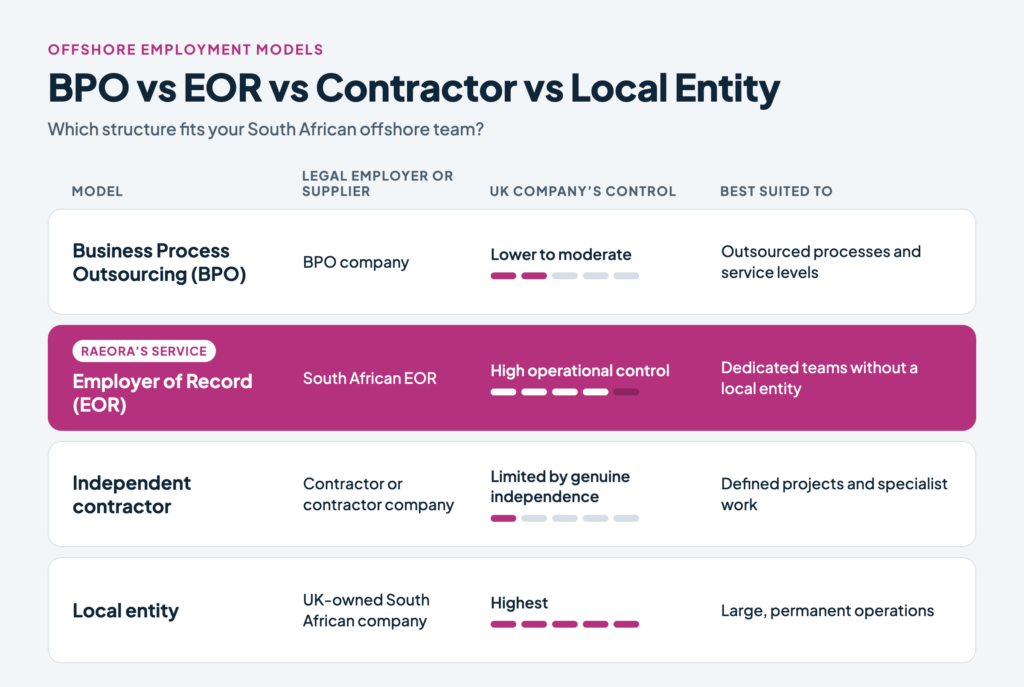
The right structure depends on team size, duration, control and the nature of the work. A Business Process Outsourcing (BPO) provider delivers an outsourced process. An Employer of Record (EOR) is usually suitable when a UK company wants to manage dedicated South African employees without opening a local entity. Contractors are more appropriate for genuinely independent, project-based work. In South Africa, simply calling someone a contractor does not remove employment or tax risk. Below a set earnings threshold, the law presumes that a person working for a client is an employee, regardless of what the contract says, if any one of several factors is present, such as working under the client’s direction or depending economically on that client. A local entity, by contrast, offers the most long-term control but takes longer and costs more to set up.
How to Build an Offshore Team in South Africa
South Africa offers UK companies access to top talent at a more cost-effective rate than in the UK. Accessing the right skilled professionals to suit a company’s needs requires a step-by-step approach.
Steps to build an offshore team in South Africa
- Define the roles and expected outputs.
- Select the appropriate city and employment model.
- Benchmark total costs.
- Recruit locally.
- Prepare compliant employment contracts.
- Establish secure infrastructure.
- Implement a structured onboarding and performance-management plan.
On the surface, building a South African-based offshore team might seem straightforward. However, legal and tax requirements, nuances in local labour law and the time it takes to become operational must also be factored in. Many companies opt to partner with a local EOR provider because it can significantly simplify the process.
How to Manage a UK–South Africa Offshore Team Successfully
Generally, the most successful offshore teams are those that are integrated into a company and understand how their work fits the wider business. In practice, South African employees should have access to the same operational information, training, feedback and company communications as their UK colleagues. Set clear weekly priorities and use a predictable rhythm of team meetings. Ensure that there are individual check-ins and regular performance reviews. These processes need to be transparent and consistent with South African data protection laws and employment requirements. Managers should also define which matters require real-time discussion and which can be handled asynchronously.
Offshore Team Management Timeline
- First week: systems training, introductions and role expectations.
- First 30 days: frequent support and weekly performance feedback.
- Monthly: KPI review, workload discussion and development planning.
- Quarterly: role progression, compensation and retention review.
- Ongoing: shared documentation, security training and integrated team meetings.
What South African Employment and Tax Rules Apply to Offshore Teams?
South African employment and tax laws apply to employees working in South Africa. The precise obligations depend partly on the employment structure used. For example, UK companies employing people in South Africa must consider working hours, statutory leave (including annual, sick and maternity leave), Pay-As-You-Earn (PAYE), Unemployment Insurance Fund (UIF) and Skills Development Levy (SDL).
Employing staff directly in South Africa without a local entity can create tax and permanent-establishment exposure for a UK company, depending on the work the team performs. RAEORA can help UK businesses build dedicated offshore teams in South Africa faster, without establishing a local entity, while remaining compliant with the country’s employment and tax laws. Through its EOR service, RAEORA acts as the local legal employer: it recruits, hires and onboards skilled South African employees, prepares employment contracts that comply with local law, and manages monthly payroll, deductions and statutory contributions. It also provides HR, performance-management and fair and lawful termination support.
How Do UK GDPR and South Africa’s POPIA Apply to Offshore Teams?
The UK General Data Protection Regulation (UK GDPR) governs how organisations process personal data. It applies alongside the UK Data Protection Act 2018. The South African Protection of Personal Information Act (POPIA), Act 4 of 2013, establishes conditions for the lawful processing of personal information by public and private bodies. It has a broadly comparable purpose to the UK GDPR. Although their requirements are not identical, both laws require personal information to be processed lawfully, for defined purposes and with appropriate security safeguards. Depending on the parties, their locations, their legal roles and the direction in which the personal information is transferred, an offshore arrangement may involve both the UK GDPR and POPIA.
Where Should You Build an Offshore Team in South Africa?
Cape Town is South Africa’s leading offshore destination, followed by Durban and Johannesburg, according to BPESA (2025).
Reasons to Offshore to Cape Town
- Cape Town’s talent pool, from STEM graduates to remote-ready professionals, is backed by a mature recruitment and EOR ecosystem.
- Cape Town’s tech hub is one of Africa’s strongest, giving global businesses access to skilled tech talent and startup innovation.
- Cape Town’s fintech sector is a growing hub for financial services, well suited to building remote finance teams.
How Can a South African EOR Help a UK Company Build an Offshore Team?
An EOR partnership offers a practical route for UK companies that want a dedicated South African team without immediately establishing a local company. This hiring model can enable a UK company to employ skilled talent more easily and quickly than if the hiring is managed itself. It can also be a more cost-effective way to run a South African team than establishing a local entity, and it typically gets the team operational sooner. Because a South African EOR is locally based and acts as the legal employer, it manages compliance with South Africa’s employment and tax laws, helping its client stay compliant.
RAEORA’s comprehensive EOR services can support a UK company’s offshoring process, from job-description development and candidate sourcing to onboarding, payroll and ongoing employee relations. Clients retain control over technical direction, standards and daily priorities, while RAEORA as the EOR provider, manages the local employment framework. Justin Durandt says that, in his experience, the RAEORA EOR approach allows clients to test the South African market, begin with a small team and scale up.
Seven Key Advantages of an EOR
- Lower expansion risk.
- Lower operational costs.
- Faster rollout.
- Streamlined payroll and benefits administration.
- Access to local talent and market insight.
- Labour law compliance and reduced legal risk.
- More time to focus on core operations.
Explore our EOR services for UK companies, or get in touch with RAEORA to discuss how we can tailor your South African offshore needs, with flexible payment options to suit your hiring strategy.
FAQs
What does offshoring to South Africa mean? Offshoring to South Africa means building a South African team to perform selected business functions while the company’s main operations remain in the UK.
Why do UK companies offshore to South Africa? South Africa offers UK companies skilled English-speaking talent, competitive employment costs and a favourable time zone difference.
Which roles can be offshored to South Africa? Suitable roles include customer service, accounting, payroll, administration, recruitment, IT support, software development, data analysis, digital marketing and sales support.
How much can a UK company save by offshoring to South Africa? Savings depend on the role, seniority and employment model. Companies should compare total employment costs, including salaries, benefits, statutory contributions, equipment and EOR fees, to see how much they could save by offshoring to South Africa.
Can a UK company hire South African employees without opening a local entity? Yes, a South African Employer of Record (EOR) can legally employ staff on a UK company’s behalf, so the company does not need its own local entity.
Share

Fast-tracking workforce expansion comes with an escalated company risk and requires resources. It can be a timeous process that’s arduous and complicated, especially when it’s abroad. This is how the right EOR service partner can decrease risk, time and costs.

Fast-tracking workforce expansion comes with an escalated company risk and requires resources. It can be a timeous process that’s arduous and complicated, especially when it’s abroad. This is how the right EOR service partner can decrease risk, time and costs.

Recruiting talent efficiently means employing South African professionals for remote based support services work. This is why using an EOR service is ideal.

Fast-tracking workforce expansion comes with an escalated company risk and requires resources. It can be a timeous process that’s arduous and complicated, especially when it’s abroad. This is how the right EOR service partner can decrease risk, time and costs.