
Share

Hiring is expensive and UK recruitment agency fees are only one part of the total bill. The final costs of hiring include salary, National Insurance, pension contributions and benefits package, onboarding and the cost of an unfilled role. Most potential clients ask “what percentage do you charge?” A better question is, “Will this model get us the right person, keep cash flow manageable, and protect us if it doesn’t work out?”
RAEORA Offers Three Ways to Structure the Recruitment Process and its Fees
There’s no single correct way to price a search as it depends on the role, the timeline and how much cash-flow flexibility you need. RAEORA offers three different structures, so you can pick the one that actually fits how you hire.
- 1
Standard Recruitment terms.
- 2
Reduced-fee model.
- 3
Strategic staffing partnership.
How Are Recruitment Agency Fees Priced in the UK?
RAEORA’s Managing Director, Justin Durandt, says “In the UK, recruitment agencies generally charge a fee based on a percentage of the successful candidate’s annual starting salary, although the exact percentage will vary between agencies and assignments.”
What to Compare When Looking at Agency Fees
- Whether bonuses or commissions are included.
- When payment is due.
- If VAT is an additional charge.
- The duration of the replacement period.
- What happens if an employee leaves early.
NB: Remember to ask to see this in writing before you sign anything – verbal estimates rarely match the final invoice.
What is the True Cost of Hiring an Employee in the UK?
Cost per hire in the UK is rarely just the agency invoice. In the 2026/27 tax year, most employers pay Class 1 National Insurance at 15% above the £5,000 annual secondary threshold. Eligible employers may be able to reduce part of this liability by claiming Employment Allowance. Generally, the minimum employer pension contribution is 3% of qualifying earnings. This is subject to the scheme and the employee’s eligibility.
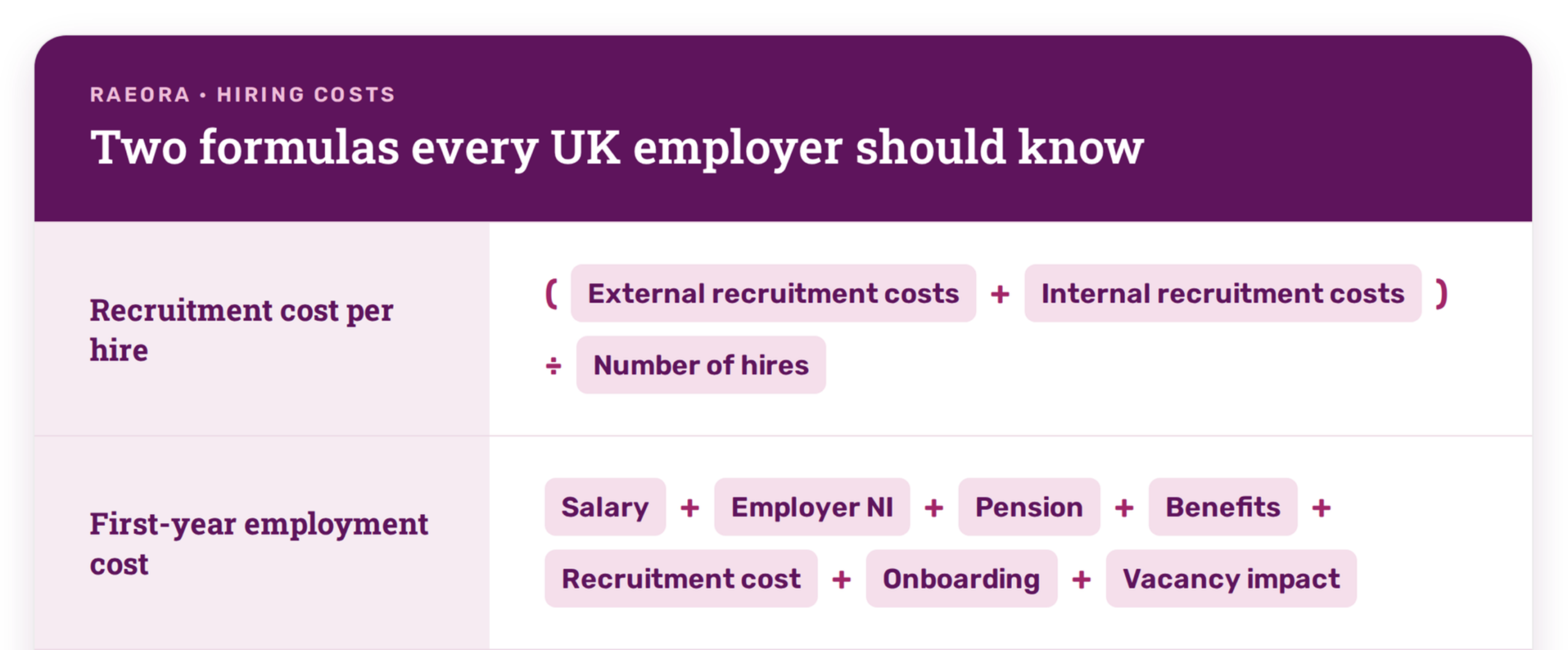
The agency fee is the number everyone fixates on, but it is only one part of the total first-year cost of hiring. A true hiring calculation also needs to include internal time, salary, employer National Insurance, pension contributions, onboarding, benefits, vacancy delays and early attrition.
True Cost of Hiring a £50,000 Employee in the UK: A Worked Example
First-year cost of a £50,000 hire: approximately £69,013 (before benefits and vacancy costs).
Take a role paying £50,000 a year. If the agency fee is an illustrative 18%, the fee would be £9,000. Adding £800 of management time and £150 for checks brings the recruitment cost to £9,950. Add £1,000 for onboarding the new hire. Employer NI (15% of the £45,000 above the £5,000 threshold) is £6,750 before any Employment Allowance. A minimum 3% employer pension contribution on qualifying earnings (£6,240–£50,270) adds about £1,313. That brings the first-year cost to roughly £69,013, and benefits and the cost of the vacancy come on top of that.
RAEORA’s Three Recruitment Fee Models Compared
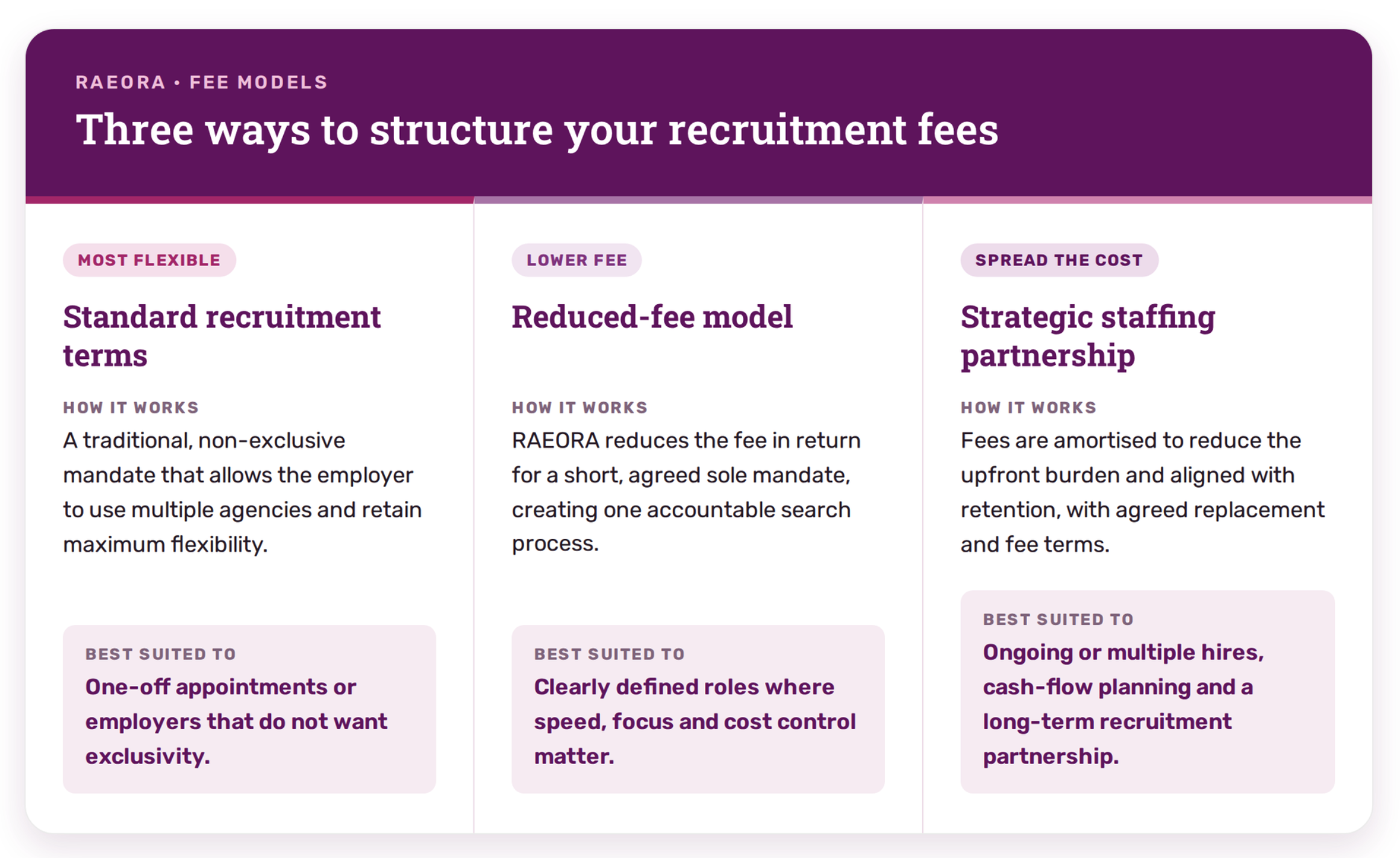
The lowest recruitment fee is not always the best-value option. This is because a cheaper arrangement may offer less search support, flexibility or protection if the appointment ends early. RAEORA offers standard non-exclusive recruitment, a reduced fee for a limited sole mandate and a strategic staffing partnership with amortised, retention-aligned fees. Clients can then choose the arrangement that best fits the role, hiring timetable and available budget.
“We developed our partnership model in direct response to our clients’ evolving needs. While they value exceptional recruitment outcomes, they also need solutions that align with cash flow realities, support sustainable growth, and create genuine long-term value. Rather than adopting a one-size-fits-all approach, we wanted to offer flexible options that foster true partnership, encourage shared commitment and risk, and strengthen relationships built for long-term success.” Allan Pike, CEO, RAEORA
Each of RAEORA’s models involves a different trade-off. Standard terms keep your options open. Go sole mandate and the fee drops, but so does your flexibility. And strategic staffing is intended for businesses making several hires, not just one.
How to Reduce Recruitment Costs without Lowering Quality of Hire
In their Resourcing and Talent Planning Survey 2020, CIPD advises that, when seeking to contain recruitment costs, it’s best to “Put a range of robust measures in place to assess the return on investment of your recruitment activity.”
How to Control Hiring Costs
- Properly defining the role: Start with a signed-off job brief, realistic salary range, agreed scorecard and named decision-makers. Repeated briefing changes, slow feedback and misaligned interview panels create avoidable work and candidate drop-off.
- Selecting the right fee model: Match the fee model to the hiring plan. A one-off appointment may need flexibility, while planned growth may benefit from spreading fees over time.
- Consolidating accountability: A limited sole mandate can prevent duplicated effort and give one recruiter clear accountability.
- Measuring retention: Track probation completion, 90-day performance and 12-month retention. A hire who performs well and stays longer provides better value by reducing repeat recruitment, onboarding and lost-productivity costs.
- Calculating cost per hire: Add agency fees, advertising, screening, management time and other recruitment expenses, then divide the total by the number of successful hires. A low cost per hire is not a genuine saving if the employee leaves after three months or fails to perform in the role.
Don’t judge an agency by the size of the pile of CVs they send over. Judge them on how many of those people you’d interview. This means looking at the quality of the shortlist, the time it saves your managers and the support the recruitment agency provides throughout the appointment process.
An Illustrative UK Hiring Example About Recruitment Return on Investment (ROI)
Calculating recruitment ROI involves comparing the financial contribution of a new hire to a company’s bottom line with the total investment required to recruit and onboard them. Recruitment ROI shows whether the money spent on hiring translates into employees who perform, stay and add value to the business. So, run this calculation before you negotiate a fee, not after – it changes what you’re willing to pay for.
Recruitment ROI Example: Four Hires, 400% Return
For example, imagine a UK business that needs to recruit four specialists, each earning an average salary of £55,000. Using an illustrative 18% agency fee, agency spend would be £39,600. Add £4,400 for internal time, checks and onboarding, and the total recruitment investment would be £44,000. If those hires generate £220,000 in profit contribution after their salary and employment costs during year one, the recruitment investment produces an illustrative ROI of 400%.
In this example, if the same £39,600 fee were spread over six months, you would pay £6,600 a month instead of £39,600 upfront. The total agreed fee may not change, but there would be less immediate pressure on cash flow. Depending on the agreed replacement and fee provisions, retention-aligned terms may also reduce the employer’s financial exposure if someone leaves early.
Choose a Recruitment Model That Fits Your Hiring Plan
Chasing the lowest fee is the wrong game. You want a hire who’s still there in eighteen months.
The best fee model for you will depend on whether your business needs flexibility, a focused search or a longer-term staffing partnership. RAEORA can compare the three structures against your business requirements to help you determine which fee model suits your company’s needs best. Talk to RAEORA about your vacancies, hiring forecast and cash-flow priorities, and ask for a transparent comparison of the three options.
FAQs:
What is a recruitment agency fee? A recruitment agency fee is what you pay RAEORA for finding and placing a candidate. For permanent roles, that’s usually a percentage of their first-year salary, not a flat fee.
What percentage do UK recruitment agencies charge? There’s no set percentage – it depends on the role, how senior it is, and how hard it’ll be to fill. It’s best not to compare the headline number.
Does RAEORA charge candidates? No, candidates never pay us a penny. The employer covers the fee.
How does RAEORA’s reduced-fee model work? You give RAEORA a limited sole mandate, meaning RAEORA is the only agency working the role for an agreed period, and in return, RAEORA will drop the fee and run a tighter, more accountable search.
What is a limited sole mandate? One agency has the exclusive rights to fill a specific vacancy for a set window.
What is RAEORA’s strategic staffing model? RAEORA’s strategic staffing model is a longer-term arrangement, spreading the fee over time and tying it more closely to retention and replacement terms.
How should we compare recruitment quotes? Check the fee base, VAT, payment timing, exclusivity and what happens if someone leaves early. A cheaper quote that skips checks or replacement cover often ends up costing more.
Which RAEORA fee model should we choose? Which fee model suits you depends on what you’re optimising for. Need flexibility? Choose RAEORA’s standard terms. Only want to fill one role and want it handled fast by one recruiter? Then use RAEORA’s reduced-fee model. Are you hiring three or four people this year and want to spread the cash-flow hit? Then opt for RAEORA’s strategic staffing fee model.
Share

Fast-tracking workforce expansion comes with an escalated company risk and requires resources. It can be a timeous process that’s arduous and complicated, especially when it’s abroad. This is how the right EOR service partner can decrease risk, time and costs.

Recruiting talent efficiently means employing South African professionals for remote based support services work. This is why using an EOR service is ideal.

Fast-tracking workforce expansion comes with an escalated company risk and requires resources. It can be a timeous process that’s arduous and complicated, especially when it’s abroad. This is how the right EOR service partner can decrease risk, time and costs.

Recruiting talent efficiently means employing South African professionals for remote based support services work. This is why using an EOR service is ideal.